

Illustration of Nang Tani, a female spirit of the wild banana tree in Thai folklore. Artwork by ferrari.illust, published on Instagram on January 30, 2024.
Nang Tani: the woman of the wild banana tree
In the twilight beneath the wild banana trees dwells Nang Tani (นางตานี), one of the most well-known Thai ghosts in Thai folklore. It is said that she appears on nights of the full moon—a woman dressed in green, her skin tinted with a faint glow, floating a few centimeters above the ground, like a sigh caught between the leaves.
At times she appears benevolent, offering food to monks who pass beneath her branches. But to cut down the tree she inhabits is to invite misfortune. For this reason, she is honored with silk ribbons, incense, and fruit. Her figure embodies that delicate boundary between the human and the unseen.

Artistic photograph of a woman portrayed as an ancient Thai ghost, dressed in traditional attire. Source: Freepik.
Phi Tai Hong: the spirit of violent death
Phi Tai Hong (ผีตายโหง) represents the unrest of an interrupted life. These Thai ghosts are the spirits of those who died suddenly or violently, without any ritual to release them. According to tradition, their anger remains alive in the places where they fell, haunting anyone who dares to approach. During the seven days following death, their energy is said to reach its most ferocious peak.
Within this myth lies an even more sorrowful variant: Tai Thang Klom (ตายทั้งกลม), the spirit of a mother who dies with her child still in her womb. That double loss amplifies both her strength and her grief—a tale that speaks as much of pain as it does of memory.

Digital illustration of a bakeneko, a cat spirit from Japanese folklore known for its ability to shapeshift and manipulate humans. Author: savagepassion.
Cha Kla: the spectral cat
Cha Kla (จะกละ or ผีจะกละ) is a feline spirit from Thai folklore, particularly common in the central and southern regions of the country. Its origin traces back to tales of magic and witchcraft recorded in the ancient Three Seals Law Code from the Ayutthaya period, where it was already described as a creature feared for its supernatural powers. Legend says it is feared not only by villagers but also by sorcerers, some of whom were believed to be capable of summoning it to attack their enemies. In southern Thailand, it is known as Phi Luang, and many families grow up hearing warnings about this being, whose black skin and red eyes illuminate the darkness of the night.
Its fur, which grows in the opposite direction, gives it an unnatural appearance. Seeing it, touching it, or even simply crossing its path is associated with death or immediate misfortune. Thus, Cha Kla transcends the image of a mere monster to become a symbol of the hidden dangers within the jungle’s depths—and of the fears that Thai culture associates with the night and black magic.
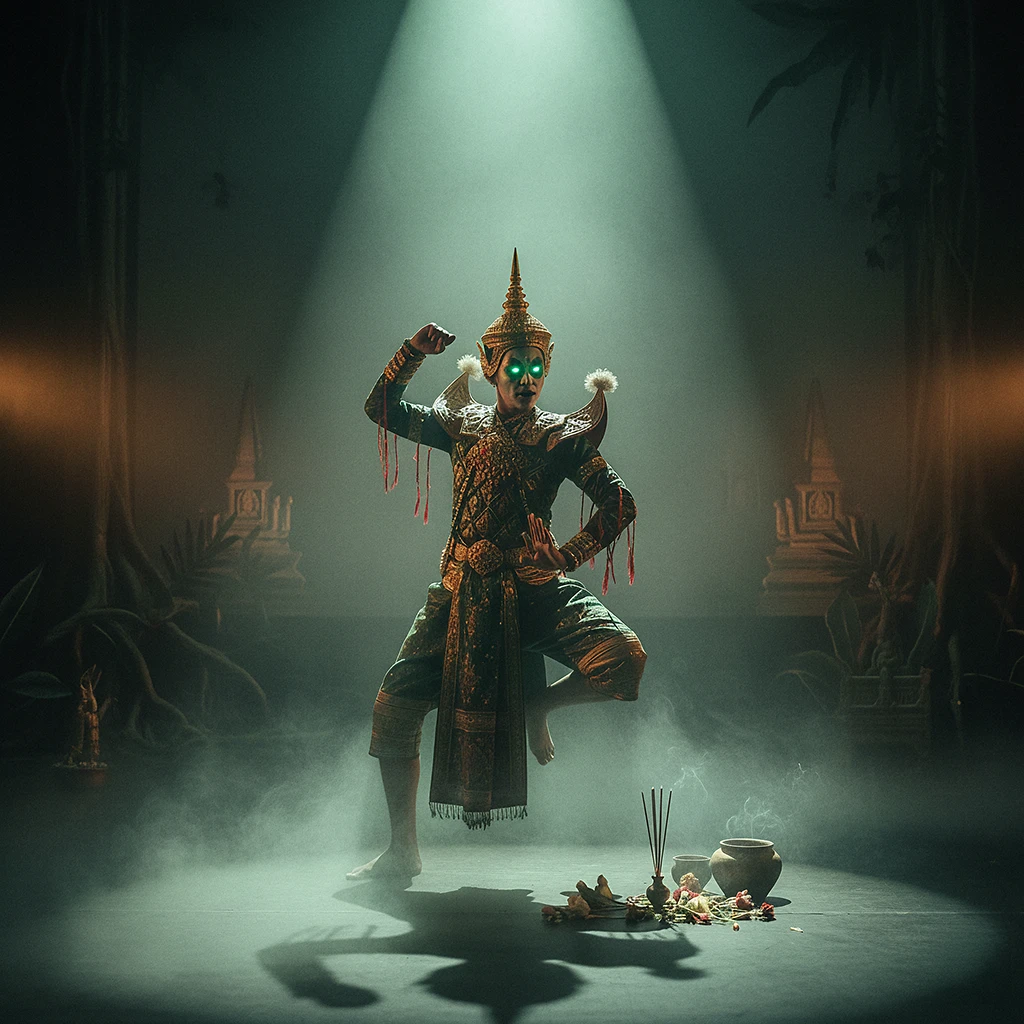
Kong Koi: the one-legged ghost
The myth of Phi Kong Koi (ผีกองกอย) is deeply rooted in the folklore of Thailand and Laos, with many regional variations. Beyond its hopping figure, some versions describe it as a small ape-like creature or a frail child, with a swollen belly, dark skin, and agile movements. Some say its mouth is shaped like a tube—similar to that of a mosquito—reinforcing the belief that it sucks the blood of travelers as they sleep deep in the jungle. This trait, together with the repetitive sound of “koi, koi, koi,” has made this spirit a blend of predator and legendary vampire.​
In local traditions, walking barefoot or leaving belongings along the path is seen as an invitation to disaster, as it is said that any object found in the jungle might “belong” to Phi Kong Koi—removing it would provoke its anger. For some ethnic groups, the legend may even have been inspired by the existence of ancient nomadic tribes (such as the Sakai or Kha Ra Dae), around whom stories of cannibalism and ambushes of travelers were told. Tales from wandering monks recount encounters with these beings, escaping unharmed through meditation and spiritual calm.​
Contemporary testimonies of strange footprints or nocturnal sounds attributed to Phi Kong Koi continue to fuel its reputation, keeping alive both respect and fear toward this specter that watches over the jungle paths of Southeast Asia.
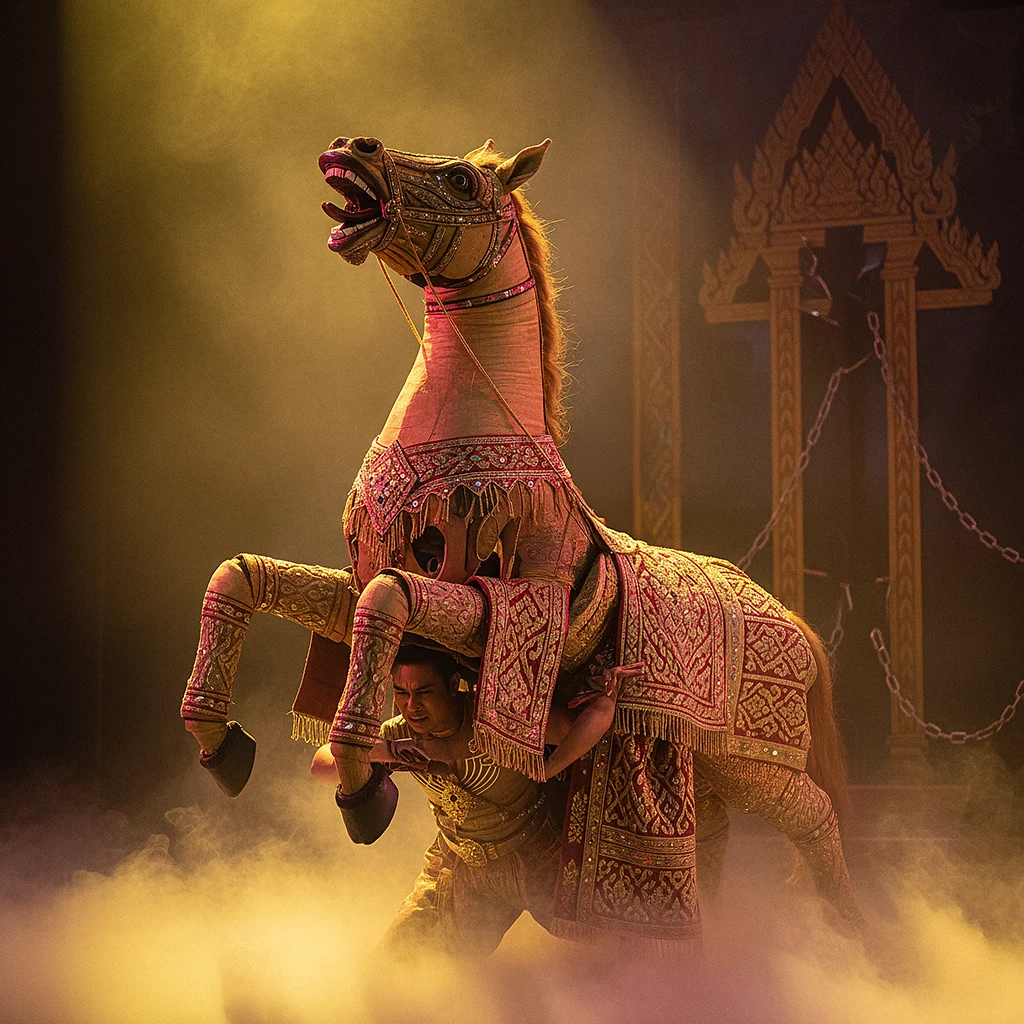
Ma Bong: the spirit of the horse and betrayal
Ma Bong (ผีม้าบ้อง), also known as Phi Ma Bong or simply Phi Ma, is one of the Thai ghosts deeply rooted in the beliefs of the Lanna people in northern Thailand. Its appearance varies across stories: some describe it with the lower body of a horse and the upper body of a man, while others tell of a half-woman, half-horse figure that lures young men only to harm them. A constant in all versions is its connection to horses, often manifesting through neighs and the sound of hooves, leaving behind mysterious tracks that vanish without explanation.
A popular tale recounts how two friends used to go out together at night; at one point, one wandered off and was found sucking on the dried head of a buffalo. After a monk intervened using chili, the friend fled, and the other was transformed into Ma Bong—embodying a tormented spirit with the body of a half-horse. Sightings of Ma Bong have been reported in places such as Phrae and Tak, typically on a specific night of the Buddhist calendar, where it appears as a large, riderless horse, sometimes associated with ancient warriors and rural paths, especially near the Ping River in Chiang Mai. Its appearance evokes both fear and reverence and continues to persist in popular culture, even being portrayed in recent Thai television dramas.

Illustration of Krasue, a nocturnal female spirit from Southeast Asian folklore. Artwork by Xavier Romero-Frias (2012), based on traditional tales of Thai ghosts.
Phi Krasue: visceral terror
Phi Krasue (กระสือ) is one of the most terrifying and emblematic female Thai ghosts in Thai and Southeast Asian folklore, with variations also found in Cambodia and Laos. She is described as the floating head of a young and beautiful woman, with her internal organs —stomach, intestines, often heart and others— hanging from her neck, swaying as she wanders through the night. Her lower body is invisible or absent, so she drifts just above the ground, leaving behind a glowing halo resembling a will-o’-the-wisp, which modern explanations attribute to natural gases like methane in swampy areas.
According to legend, Krasue is a cursed woman or a victim of black magic who, due to some transgression in life, was condemned to this grotesque and ravenous form. Some stories trace her origin to a Khmer princess who was burned at the stake but saved by an enchantment that preserved her head and organs. At night, Krasue seeks fresh blood and flesh to satisfy her insatiable hunger, attacking animals and, occasionally, humans. During the day, she hides in human form, usually appearing pale and exhausted.
This spirit is traditionally accompanied by Krahang, a male figure who flies using rice baskets and exhibits similarly sinister behavior. The legend of Krasue remains alive in Thai culture, blending moral warnings, superstition, and terrifying encounters that have endured for generations. Today, her influence extends into film and popular culture, continuing to evoke both fear and reverence toward the invisible and the inexplicable.