

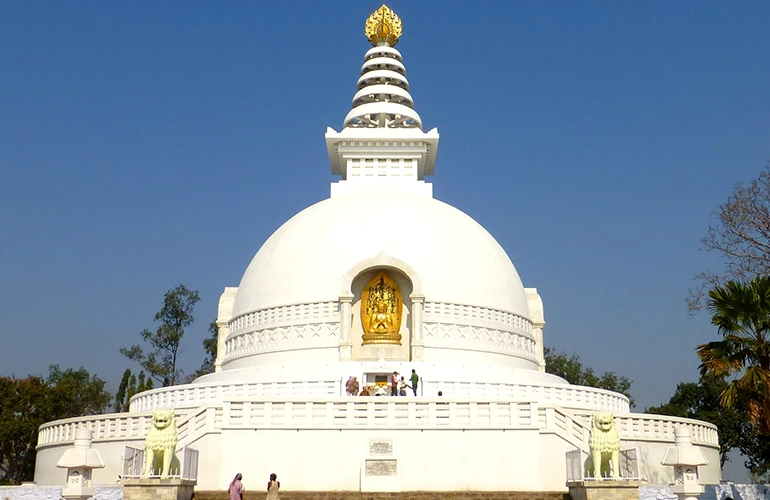
 Vishwa Shanti Stupa, built on the ancient mango grove donated by Jivaka, the Buddha’s personal physician.
A rough beginning is not the end
Jivaka’s story begins in a harsh way.
According to ancient Buddhist texts, he was born in Rajagriha —present-day Rajgir, in India— and the one who would become the Buddha’s physician was abandoned shortly after birth. His mother, a courtesan named Salavati, decided to leave him on the street out of fear of social rejection.
The child survived almost miraculously. He was found by Prince Abhaya, son of King Bimbisara, who decided to adopt him and raise him within the royal court. That gesture completely changed his destiny. Because Jivaka grew up surrounded by education, knowledge, and access to a training reserved for very few.
However, the ancient texts recount that, upon discovering he had been adopted, he decided to forge his own path and set off for Taxila, one of the great centers of learning of the ancient world.
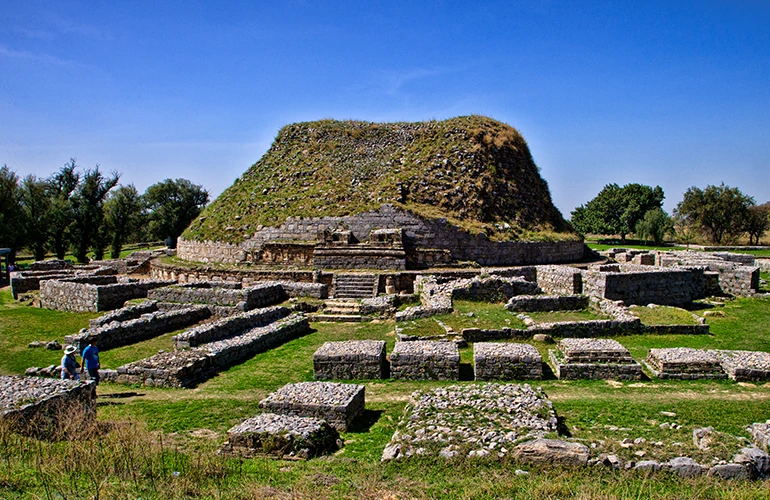 Ruins of the Dharmarajika Stupa in Taxila, the prestigious center of learning where Jivaka trained as a physician before serving the Buddha.
Taxila: the great medical center of antiquity
Long before modern universities existed, Taxila was already attracting students from different regions of Asia.
Mathematics, philosophy, astronomy, politics, and medicine were taught there. And it was precisely in that place where Jivaka studied for years under the guidance of great masters.
Indian medicine of that era combined botanical knowledge, surgery, clinical observation, and a holistic vision of health that was very advanced for its time.
Traditional accounts explain that one of his masters asked him to look for a plant that had no medicinal use. After roaming through forests and mountains, Jivaka returned saying he had not found a single one. The story is likely part legend, but it perfectly reflects the Eastern medical philosophy of the era: nature was not seen as a decorative resource, but as an immense source of balance and healing.
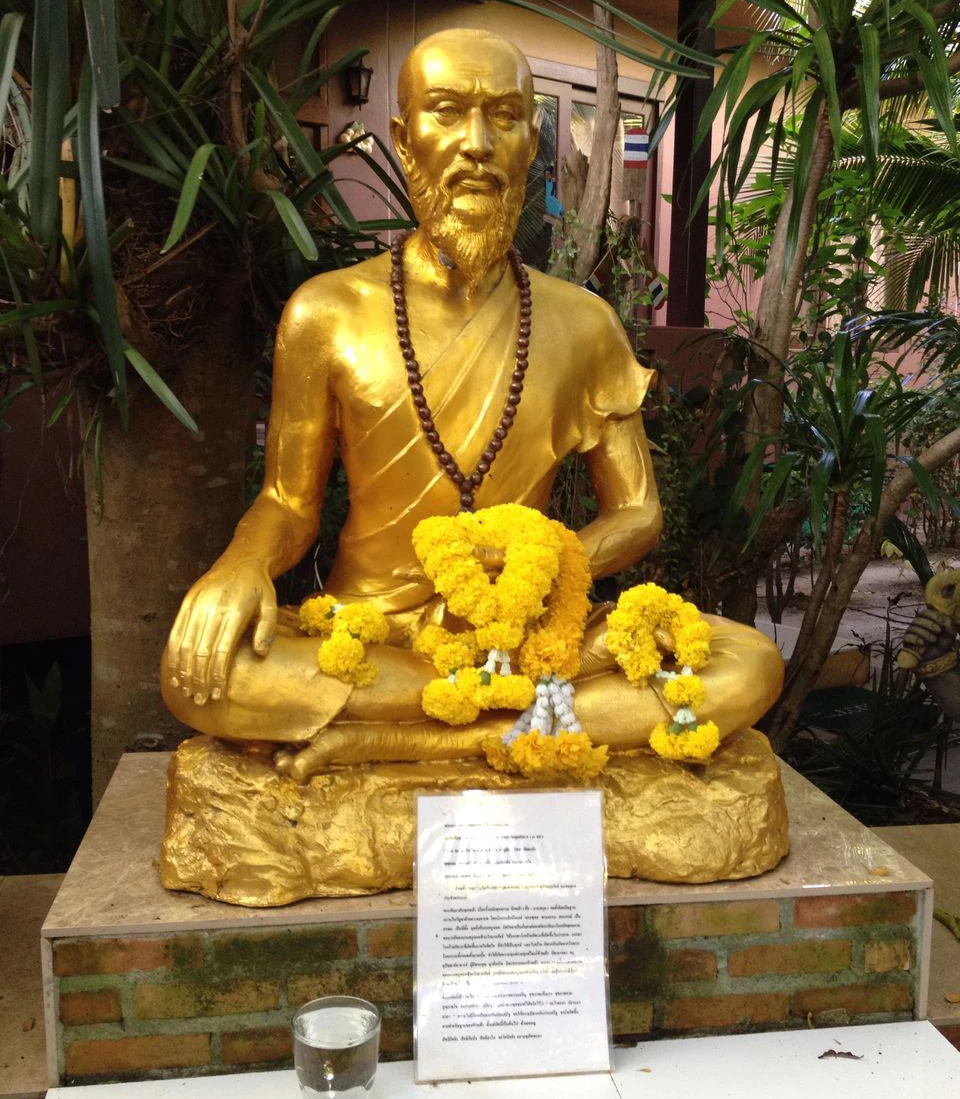 Statue of Jivaka Komarabhacca, the Buddha’s physician and revered father of traditional medicine throughout Asia.
The physician of kings and monks
After completing his studies, Jivaka returned to Rajagriha as a fully trained physician.
And it did not take him long to stand out.
Buddhist sources describe complex treatments, surgeries, and healings that earned him an enormous reputation. Over time, he became the physician of King Bimbisara and later the personal physician of Gautama Buddha.
But what is truly interesting is that his relationship with the Buddha was not limited solely to the clinical aspect.
Jivaka deeply admired the Buddhist teachings and ended up becoming one of his closest followers. In fact, he donated a mango grove —known as “Jivaka’s Mango Grove”— so that the Buddha and the monastic community could rest and gather there.
That blend of medical science and spiritual pursuit defined much of his life. It also meant reducing human suffering.
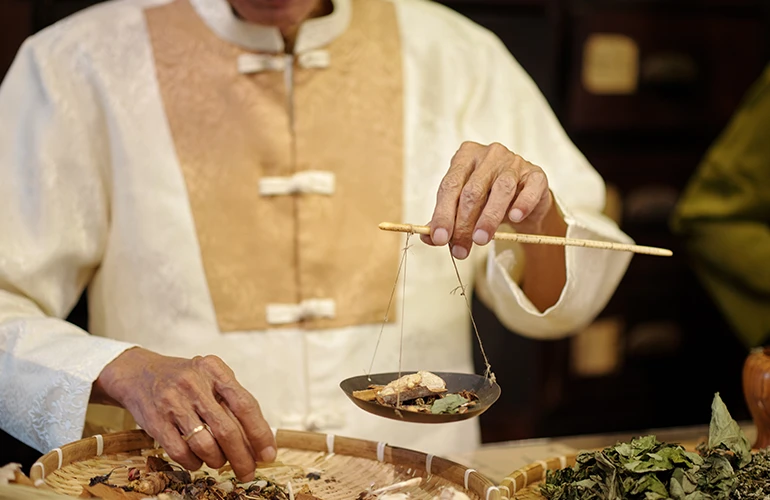
A medicine based on observation
It is striking to discover just how closely some of the methods attributed to Jivaka resembled modern medical principles.
The ancient texts speak of:
The legacy of the Buddha’s physician
More than two thousand years later, Jivaka is still remembered in many Asian countries as a fundamental figure of traditional medicine.
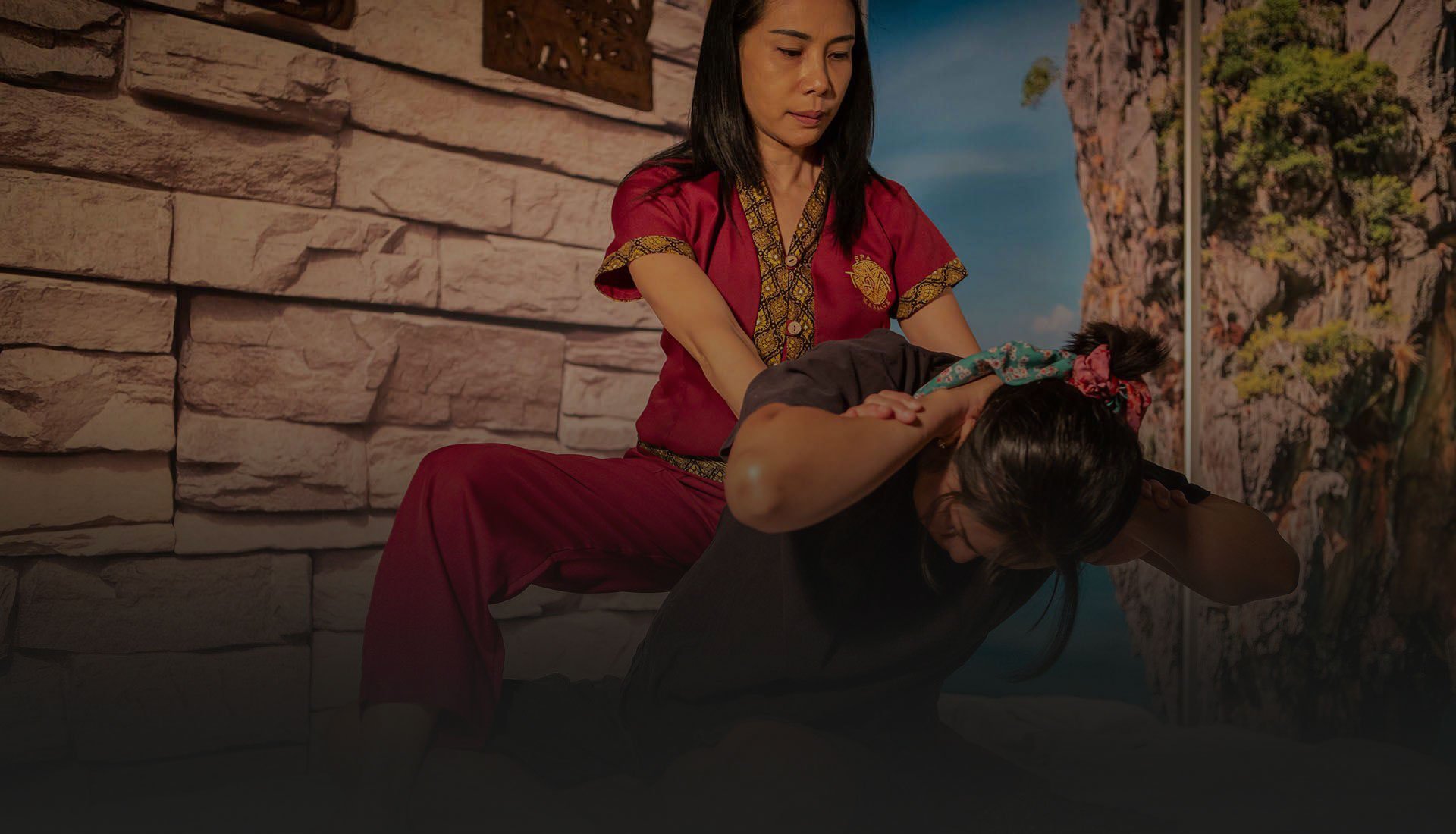
In Thailand, for example, he is considered the spiritual father of traditional Thai massage. Many massage schools still perform prayers in his honor before beginning their practice.
His figure symbolizes something that transcends cultures and eras: the idea that caring for someone is also a form of compassion.
And perhaps that is why his story still makes sense today.
Because we live in an age where exhaustion has been normalized. Where many people spend years disconnected from their own bodies. Where resting almost seems like a luxury.
Jivaka’s story is a reminder of something simple yet important: wellbeing should not be understood merely as the absence of illness, but as balance.
A balance between body, mind, and way of living.