

Myth 1: “Thai Massage Has to Hurt to Be Effective”
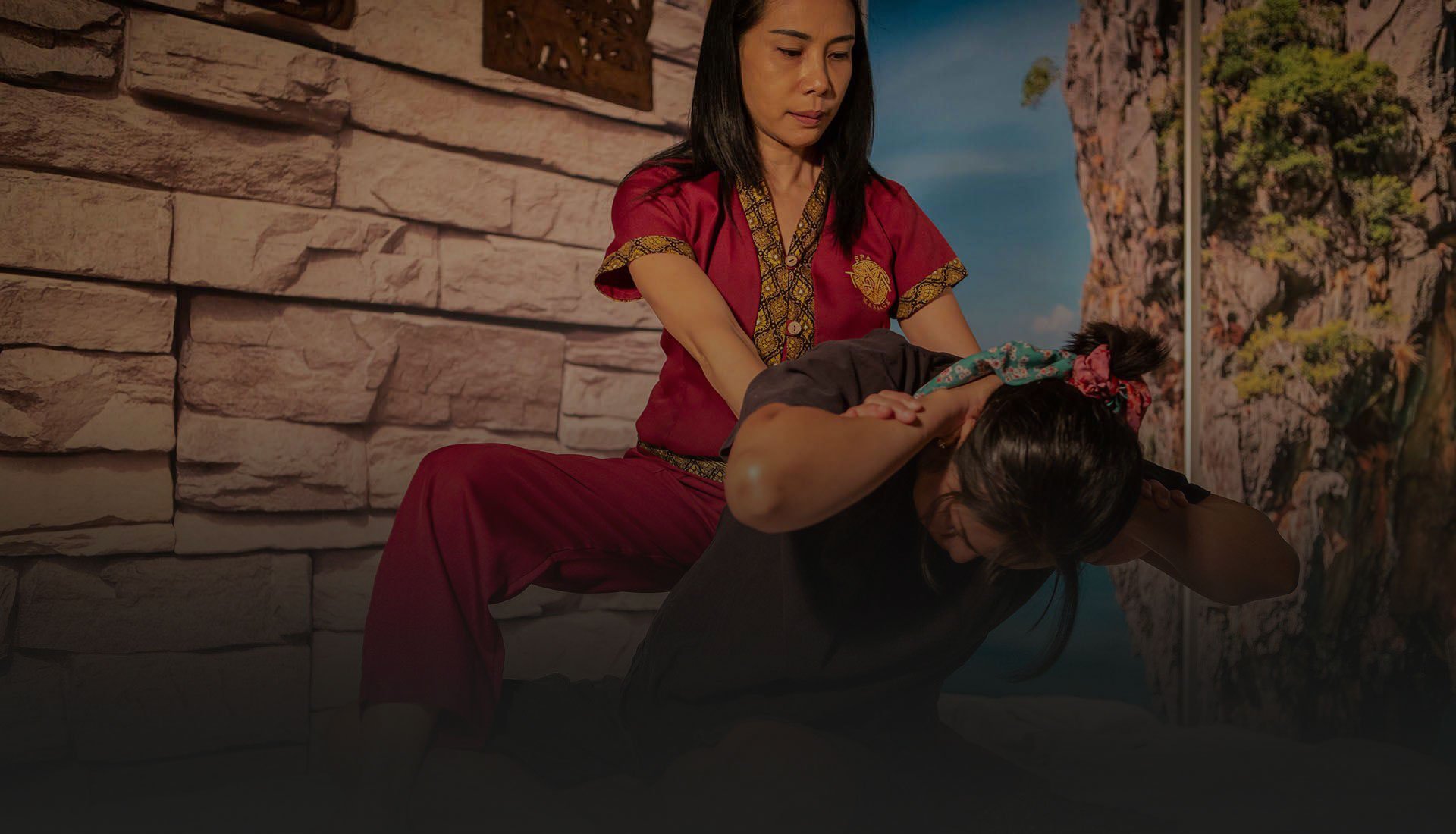
This is perhaps the most widespread belief and the one that puts people off the most. Many imagine Thai Massage as an intense experience, almost a test of endurance, where the more it hurts, the better it works.
The reality is quite different. Thai Massage does involve firm pressure and deep stretches, but its goal is not to cause pain. A skilled therapist adapts the intensity to your body, your physical condition, and your level of comfort. In certain areas of tension, you may feel a strong pressure — that “good pain” that brings relief afterwards — but it should never feel unbearable.
And one more thing: communication is key. If something feels too uncomfortable, simply say so and the session can be adjusted. A well-performed massage should leave you feeling relieved and lighter, not punished.
Myth 2: “You Need to Be Very Flexible to Receive It”
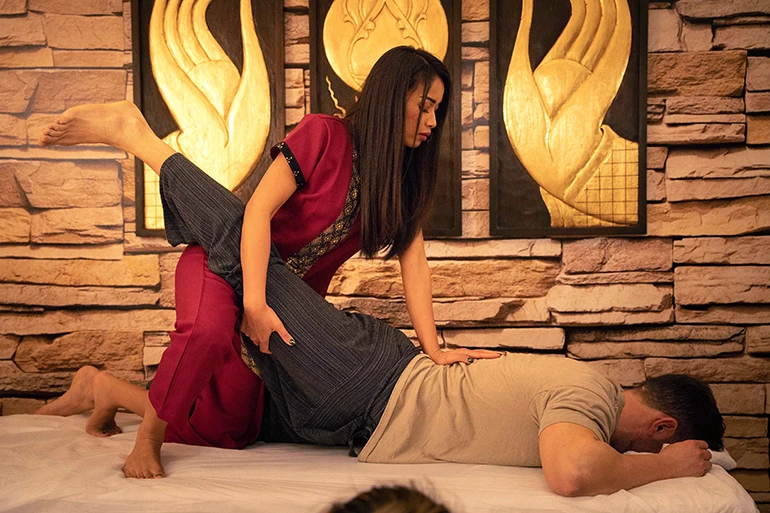
Because Thai Massage incorporates stretches inspired by yoga, many people believe it is only suitable for flexible individuals or athletes. Nothing could be further from the truth.
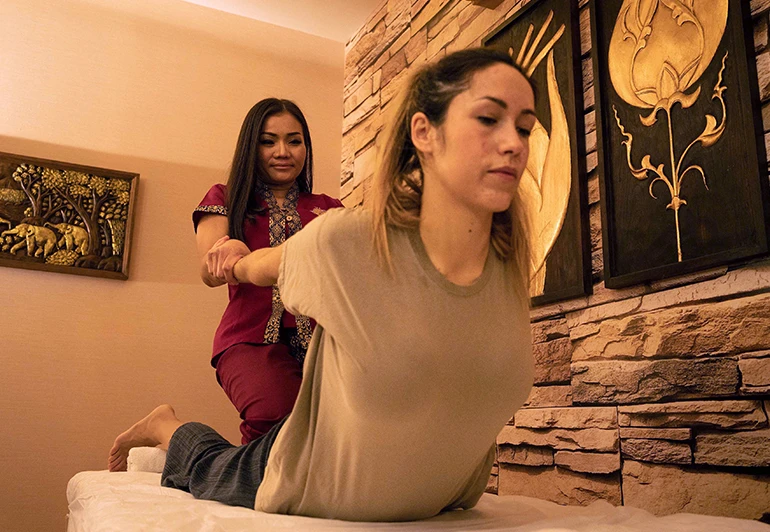
The beauty of Thai Massage is that you do not need to make any effort at all: the therapist guides every movement. You simply relax while she works with your body within its natural range of motion, without forcing anything. In fact, people with the stiffest muscles are often the ones who notice the greatest benefits, as the massage helps gradually restore mobility and flexibility. Your age and physical condition do not matter: Thai Massage adapts to you, not the other way around.

Myth 3: “It’s the Same as Any Other Relaxing Massage”
Associating Thai Massage with a Western-style massage that uses oils and soft music is a very common misconception. While both share the goal of promoting wellbeing, the techniques are completely different. This is another of the most common myths about Thai Massage.
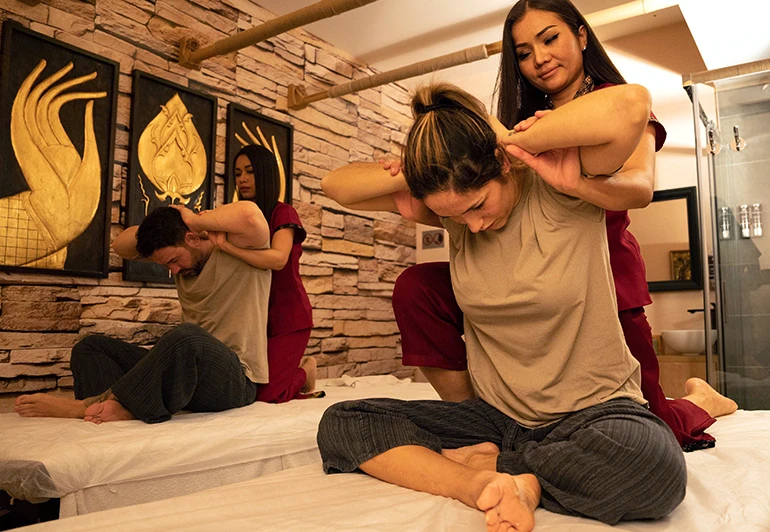
Traditional Thai Massage is performed without oils and while wearing comfortable clothing, on a treatment table or mat that allows freedom of movement. The therapist does not rely solely on their hands; they also use forearms, elbows, knees, and feet to apply pressure and guide stretches. Most importantly, the treatment works along energy lines known as Sen, following a body map passed down through Thai tradition. It is not simply a temporary relaxation experience; it is a complete system designed to create balance between body, mind, and energy.

Myth 4: “Thai Massage Has Sexual Connotations”
Associating Thai Massage with a Western-style massage that uses oils and soft music is a very common misconception. While both share the goal of promoting wellbeing, the techniques are completely different.
Traditional Thai Massage is performed without oils and while wearing comfortable clothing, on a treatment table or mat that allows freedom of movement. The therapist does not rely solely on their hands; they also use forearms, elbows, knees, and feet to apply pressure and guide stretches. Most importantly, the treatment works along energy lines known as Sen, following a body map passed down through Thai tradition. It is not simply a temporary relaxation experience; it is a complete system designed to create balance between body, mind, and energy.
Myth 5: “It Only Helps You Relax for a While”
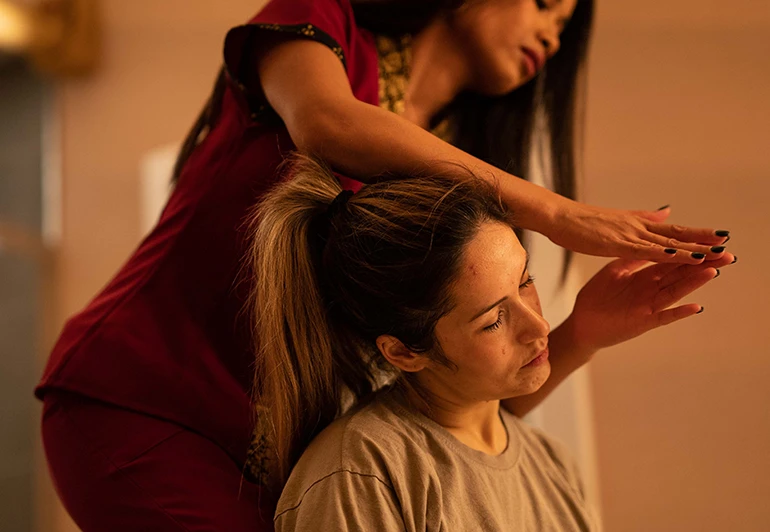
Many people believe that Thai Massage is simply an occasional treat—pleasant, but with little lasting value. This is yet another common myth about Thai Massage. In reality, its benefits go far beyond a temporary feeling of relaxation.
Thai Massage can help reduce headaches, back pain, and lower back discomfort; improve joint mobility and flexibility; contribute to better posture; support healthy circulation; and release accumulated muscular tension. On a mental level, its focus on breathing and mindfulness helps reduce stress and creates a sense of clarity that lasts well beyond the session itself. It promotes both physical and emotional wellbeing at the same time.
Myth 6: “It’s a Modern Spa Trend”
With the rise of the wellness industry, it is easy to assume that Thai Massage is a recent trend. In reality, the opposite is true: it is a practice that dates back thousands of years, passed down from generation to generation and deeply rooted in Thai culture.
Its origins are linked to Ayurvedic traditions and Buddhist medicine, and for centuries it has been taught in temples and traditional schools throughout Thailand. What you experience today in a specialised wellness centre is the result of ancient knowledge that has endured through time precisely because of its effectiveness.

Myth 7: “Anyone Can Perform It After a Short Course”
Another common myth about Thai Massage is the belief that learning a few stretches and techniques is enough to offer an authentic Thai Massage. In reality, mastering this discipline requires years of training and, above all, a deep cultural understanding that is difficult to acquire outside its place of origin.
An experienced therapist knows exactly where to apply pressure, how to guide each stretch, and when to stop, thanks to knowledge that forms part of a long-standing tradition. This intuition cannot be improvised; it is developed through education, practice, and experience. That is why the difference between an ordinary massage and an authentic Thai Massage can be felt from the very first minute.
The truth behind the myths
As you can see, much of what is said about Thai Massage comes from misunderstanding and misinformation. It does not have to be painful, it does not require flexibility, it is not just another massage, and it certainly has nothing to do with the misconceptions that are sometimes associated with it. It is a serious, centuries-old tradition with remarkable benefits for both body and mind.
The best way to leave these myths behind is to experience Thai Massage for yourself, in the hands of authentic Thai therapists. Once you try it in a professional setting, you will understand why this practice has endured for generations and why so many people who discover it make it part of their wellbeing routine.
Are you ready to discover the truth for yourself?