

What Wat Saket is and why it’s known as the Golden Mount
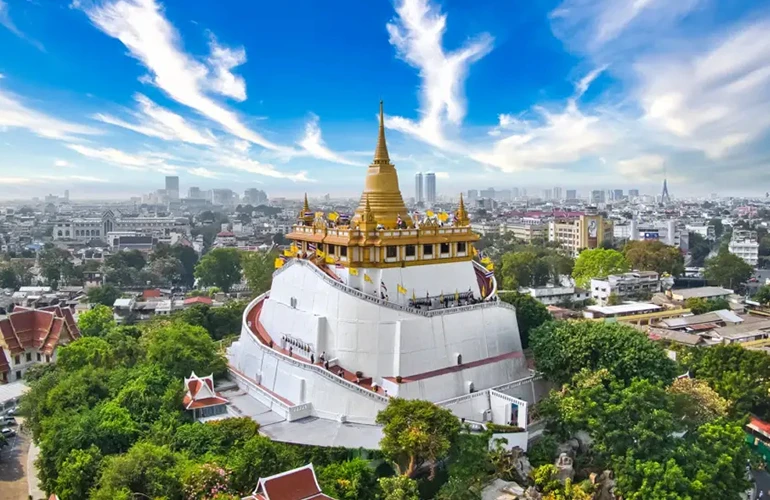
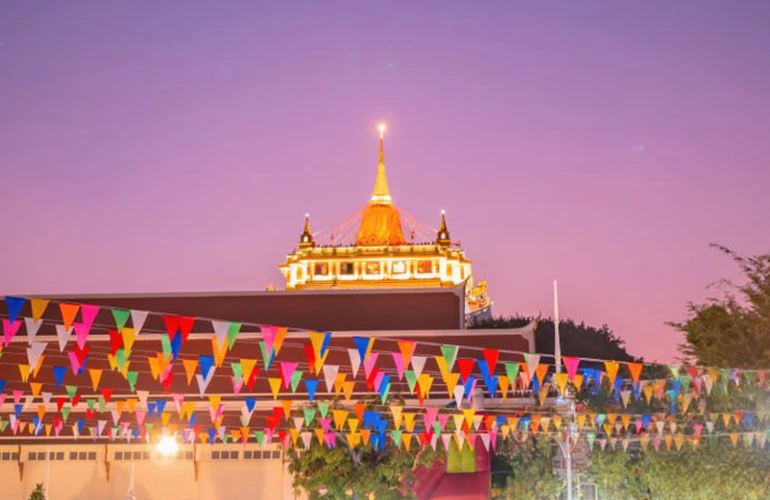
Wat Saket is one of the best-known Buddhist temples in Bangkok and is home to the famous Golden Mount, an artificial hill crowned by a large golden chedi visible from various points across the city. Although today it’s part of Bangkok’s most photographed scenery, its history dates back to the Ayutthaya period, long before the Thai capital took on its current appearance.
The temple’s full name is Wat Saket Ratcha Wora Maha Wihan, although almost everyone simply knows it as Wat Saket. The golden structure at the summit contains Buddhist relics and has become an important place of pilgrimage. To reach it, you have to climb more than 300 steps surrounded by greenery, small artificial waterfalls, statues and bells.
That climb is an essential part of the experience. It isn’t felt as a physical effort, but rather as a gradual transition between Bangkok’s frenetic pace and a far more contemplative setting. You can learn more about the temple’s official history at Tourism Thailand.
A temple tied to the transformation of Bangkok
The history of Wat Saket is deeply connected to the evolution of Bangkok. During the reign of Rama III, an attempt was made to build a large chedi at this site, but the soft ground caused it to partially collapse. Over time, nature covered the fallen structure, forming an artificial hill that would later be used to raise the present-day Golden Mount.
This detail gives it a special symbolism. What began as an architectural failure ended up becoming one of the city’s most beloved spiritual spaces. In a way, it perfectly represents an idea present in many Eastern philosophies: beauty can also arise from the imperfect, from the rebuilt, and from that which has managed to adapt over time.
During the 19th century, it also served an important function during cholera epidemics, when the area near the temple was used for cremations. Although it may seem a dark episode, today it forms part of the place’s historical memory and reinforces its connection to the idea of transition, mourning and spiritual renewal.
The experience of climbing the Golden Mount
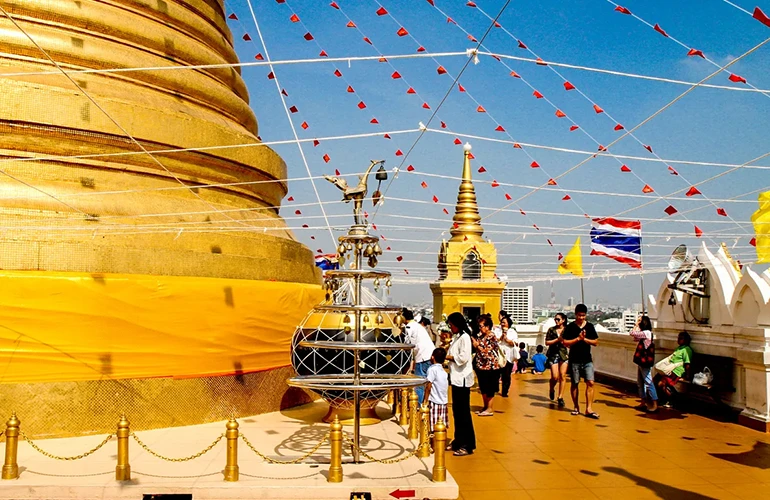
Many people arrive at Wat Saket looking for a panoramic view of Bangkok, but end up finding something different. The climb is designed to encourage a state of calm. The sound of water, the bells, the scent of incense and the greenery help create a sense of disconnection that’s uncommon in a big city.
At various points along the way there are bells that visitors ring as a symbol of good fortune. There are also Buddhist phrases, small ritual figures and spaces to pause for a few seconds before carrying on. Everything invites you to slow down.
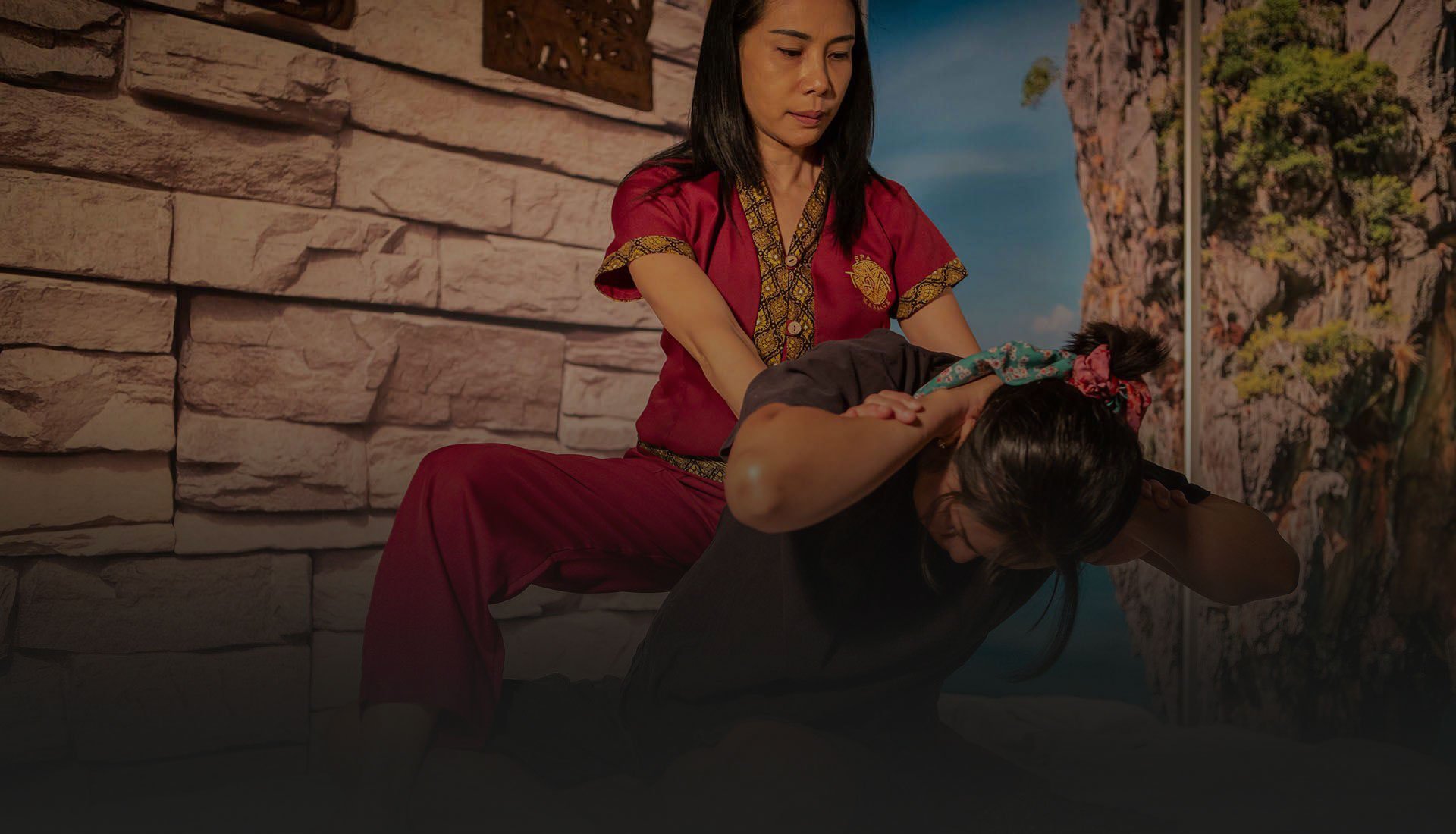
That relationship between slow movement and well-being is very reminiscent of the philosophy of traditional Thai massage. At Thai Spa Massage Barcelona, for example, we work from that very idea: well-being doesn’t come from speed, but from attention, from the right pace and from presence in every gesture.
When you finally reach the summit, the feeling changes. Bangkok appears at the visitor’s feet, immense and chaotic, while the temple maintains a serene atmosphere. That contrast is precisely part of its magic.
Wat Saket and everyday Thai spirituality
Unlike other more monumental or touristy temples, the Golden Mount retains a very close dimension for many Thais. It’s common to find people praying, leaving offerings or simply sitting in silence watching the city from above; many people visit before work, during important festivities or at moments of personal change. Thai Buddhism maintains a very direct relationship with daily life, and that is clearly felt in this temple. In Thailand, temples are not museums. They are part of everyday life.
One of the most special moments of the year is the Loy Krathong festival, when Wat Saket fills with lights, prayers and celebrations. During those days, the Golden Mount becomes one of the most active spiritual spots in Bangkok. You can learn more about Thai culture and its traditions at Thailand Insider.

A place that invites you to stop
Traveling through Thailand often means learning to slow down. And Wat Saket perfectly represents that idea. You don’t need a deep understanding of Buddhism to feel that something different is happening there. It’s enough to sit for a few minutes, listen to the wind or contemplate the city from above.
In an era where mental fatigue and overstimulation are constant, spaces like this hold enormous value. That’s why many people associate their trips to Thailand with feelings of emotional well-being and inner reconnection.
Interestingly, that same pursuit lies behind many current self-care practices. Massage, meditation, sensory rituals or even certain eating habits share a similar intention: to help us return to the body and to the present moment.
In this sense, Wat Saket is not just a historic temple. It is also a reminder that calm can be found even amid the noise.

A symbol that stays in your memory
Some places impress you visually, and others stay with you because of how they made you feel. Wat Saket belongs to this second category. The slow climb, the bells, the gold of the chedi reflecting the light of the sunset and the view of Bangkok from above create an experience that is hard to convey through photographs.
Perhaps that’s why many people who visit talk less about architecture and more about sensations. About an unexpected pause. About a feeling of lightness. About a silence that’s uncommon in such an intense city.
And maybe that’s where its true meaning lies. Not only in the history of the Golden Mount or in its religious importance, but in its ability to remind us of something very simple: that sometimes we need to stop in order to listen to ourselves again. Also, if you’d like to keep exploring temples and historic sites in Bangkok, you can check out this guide from Lonely Planet Bangkok Temples.